The Growing Value of Micronized Elemental Sulfur in Canola Rotations
Avoiding sulfur deficiencies is critical to the long-term success of a grower and their crops. Crops that are deficient in sulfur will display reduced flowering, stunted growth, yellowing in new leaves and an overall reduction in crop yield. For canola, which removes double the amount of sulfur from the soil than any other crop, avoiding and addressing these deficiencies is even more critical to success.
Micronized elemental sulfur can help growers prevent and address sulfur deficiencies in their soils, especially when growing canola in rotation, by providing growers with a constant supply of sulfur when their crops need it most. Past research with elemental sulfur has met with mixed results as the sulfur was too slow to form plant-available sulfate. Small particle size is critical for this bacterial reaction to occur quickly, but until now, it has been difficult to create a sustainable elemental sulfur product that can be applied to crops. The sulfur must be ‘micronized’ with individual particles less than 20 microns to be effective. Smart Nutrition MAP+MST delivers micronized sulfur technology to the field with phosphorus in a homogeneous granule.
Field research in a local climate was needed to verify the efficacy of MST. A three-year study, performed by soil scientists from the Northeast Agriculture Research Foundation and Agriculture and Agri-Food Canada, published three years of data comparing the effectiveness of sulfate and micronized elemental sulfur. This research was conducted on a very sulfur deficient field in northeast Saskatchewan to demonstrate its potential in the toughest conditions.
Results
The research found that micronized elemental sulfur was almost as effective as sulfate in producing high-yielding canola on extremely sulfur-deficient soil. After three years of application, the micronized sulfur source was 97% as effective as sulfate—making it one of the most effective elemental sulfur sources researched in Western Canada. Some highlights from the research include:
- In the first year of the trial, micronized sulfur was most effective in a fall broadcast application, producing almost as many bushels per acre as sulfate (88% as effective as sulfate for all treatments).
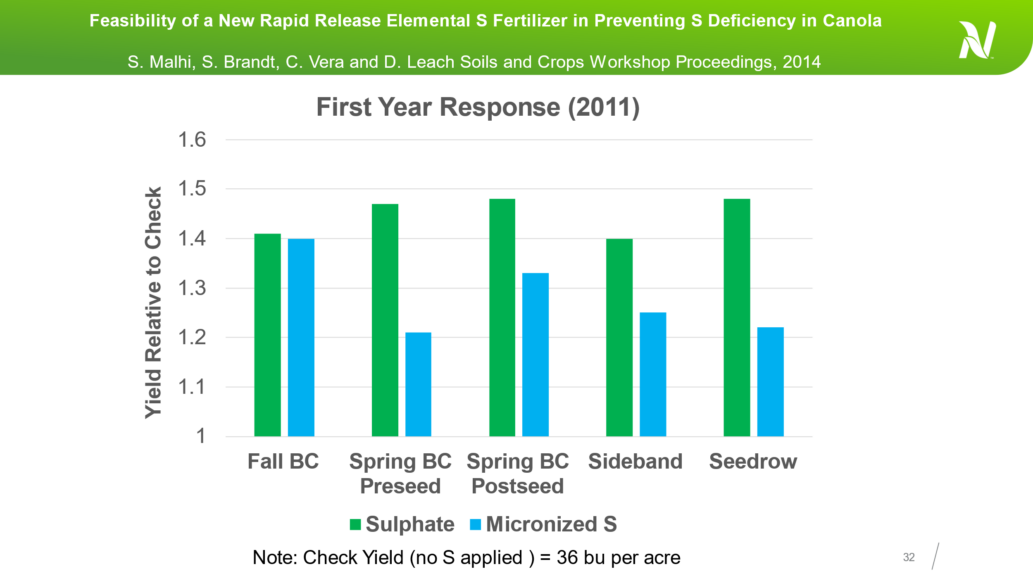
- In the trial’s second and third years, micronized elemental sulfur was most effective in a spring broadcast application increasing from 93% as effective as sulfate in its second year to 97% in its third.
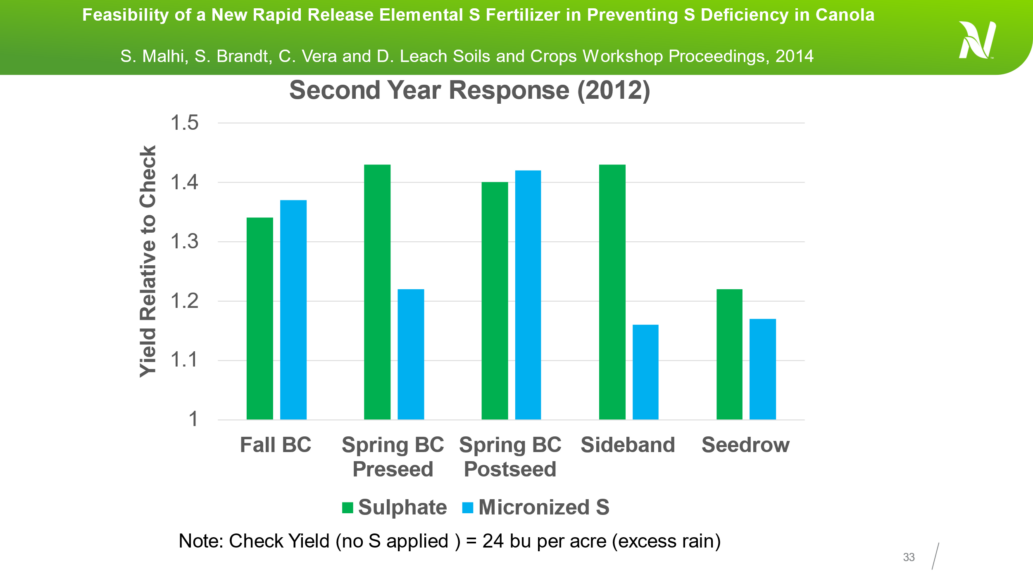
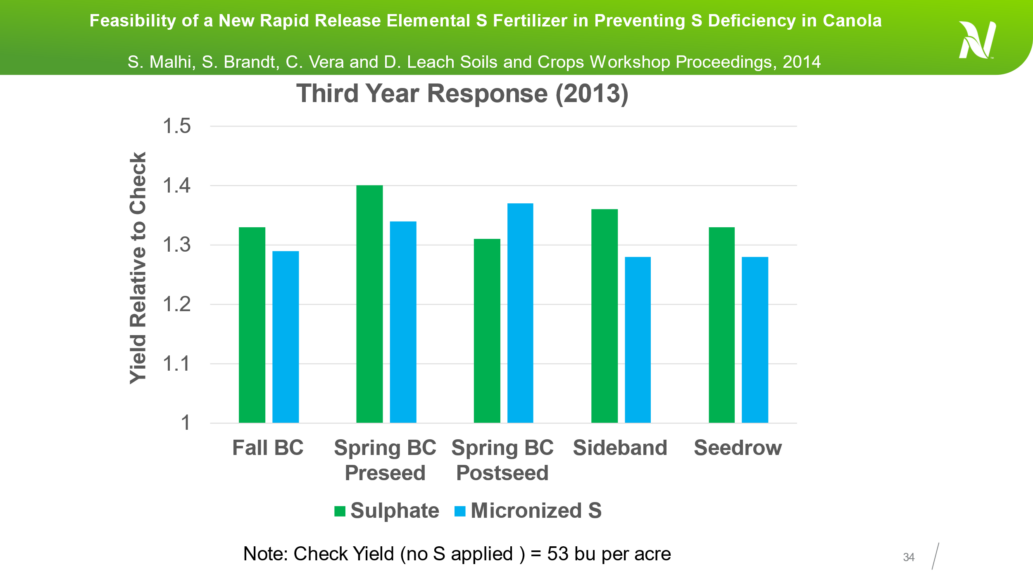
- This field research demonstrated that micronized sulfur from Smart Nutrition MAP+MST used each year in a crop rotation will become an effective and reliable source of available sulfur.
- In extremely sulfur deficient soils, a small amount of sulfate paired with micronized elemental sulfur is recommended to produce the greatest results—the short-term availability of sulfate gives the elemental sulfur enough time to oxidize and meet crop demand for the rest of the season.
These trial results point to the increased effectiveness of elemental sulfur in its micronized form. In former trials, traditional forms of elemental sulfur have struggled to produce similar yield results to sulfate. This 2014 trial set the stage for micronized elemental sulfur technology to match the effectiveness of sulfate while providing growers with greater profitability, productivity and sustainability.
Can MST prevent sulfur deficiency in canola on S-deficient soil?
While sulfate has been shown to address immediate deficiencies, support crop growth and produce slightly larger yields than elemental sulfur, it can be prone to loss in the field by leaching. Ammonium sulfate may also be limiting to safe rates of fertilizer placed near the seed so there is risk that insufficient sulfur may be applied. Micronized elemental sulfur technology addresses these issues by releasing sulfur continually with time —reducing nutrient loss, enhancing nutrient availability and maximizing crop yield and quality. Since it is initially in an elemental form, MST also has very high safety when placed near seed. The value of the technology continues to increase when used repeatedly in crop rotations.
The Power of MST
As demonstrated by research, rotational use of MST increases efficacy with each year and is a valuable source for sustainable sulfur management. Designed to provide growers with an efficient and cost-effective way to prevent and correct sulfur deficiencies with season-long availability of sulfur, Smart Nutrition MAP+MST is your partner in sustainable crop nutrition.
Learn more about how MST can support your high-yielding canola crops today or contact your local rep for more information.
Additional Reading:
Deliver Sulfur and Phosphate to Meet Your Crop’s Needs
Increasing Canola Yields with Smart Nutrition MAP+MST
Sulfur is Essential For Optimum Plant Growth
Sustainable Nutrient Management With Smart Nutrition MAP+MST
Three Symptoms of Sulfur Deficiency in Canola
Sources:
Malhi, S., Brandt, S., Vera, S., & Leach, D. (2014). Feasibility of a New Granular Rapid Release Elemental S (RRES) Fertilizer in Preventing S Deficiency in Canola on a S-Deficient Soil. Northeast Agriculture Research Foundation. Agriculture and Agri-Food Canada. https://harvest.usask.ca/server/api/core/bitstreams/74110d39-8214-4e57-9d81-9a1653674182/content