A Balanced Approach to Crop Nutrition: Nutrient Interactions and the Synergy of Phosphorus and Sulfur
All the nutrients in your soil interact with one another to support growing crops. Some nutrients complement each other, meaning they are more effective when applied together than when applied on their own. We call this type of relationship ‘synergistic’. Some nutrients compete, meaning they are less effective when one nutrient is in excess or when they are applied together rather than applied on their own. We call this relationship ‘antagonistic’.
The relationships between nutrients, applied through fertilizer or made available in the soil, have long been of interest to growers and agronomists. Various nutrient interaction charts (Figure 1) have been developed to help us better understand these relationships and the value of a balanced approach to crop nutrition.
The Importance of a Balanced Approach
Nutrients don’t operate independently – they interact to either enhance (synergize) or inhibit (antagonize) the uptake of other essential nutrients.¹ Understanding these relationships helps you manage nutrients more effectively, promoting greater profitability and productivity.
Synergistic nutrients, like magnesium and nitrogen, complement each other in the soil and work together to enhance each other’s availability. Antagonistic nutrients, like potash and boron, have such similar structures that they can hinder a plant’s ability to access the other nutrient.
Understanding Nutrient Interactions
The chart below helps you visualize both of these relationships in the soil (Figure 1).
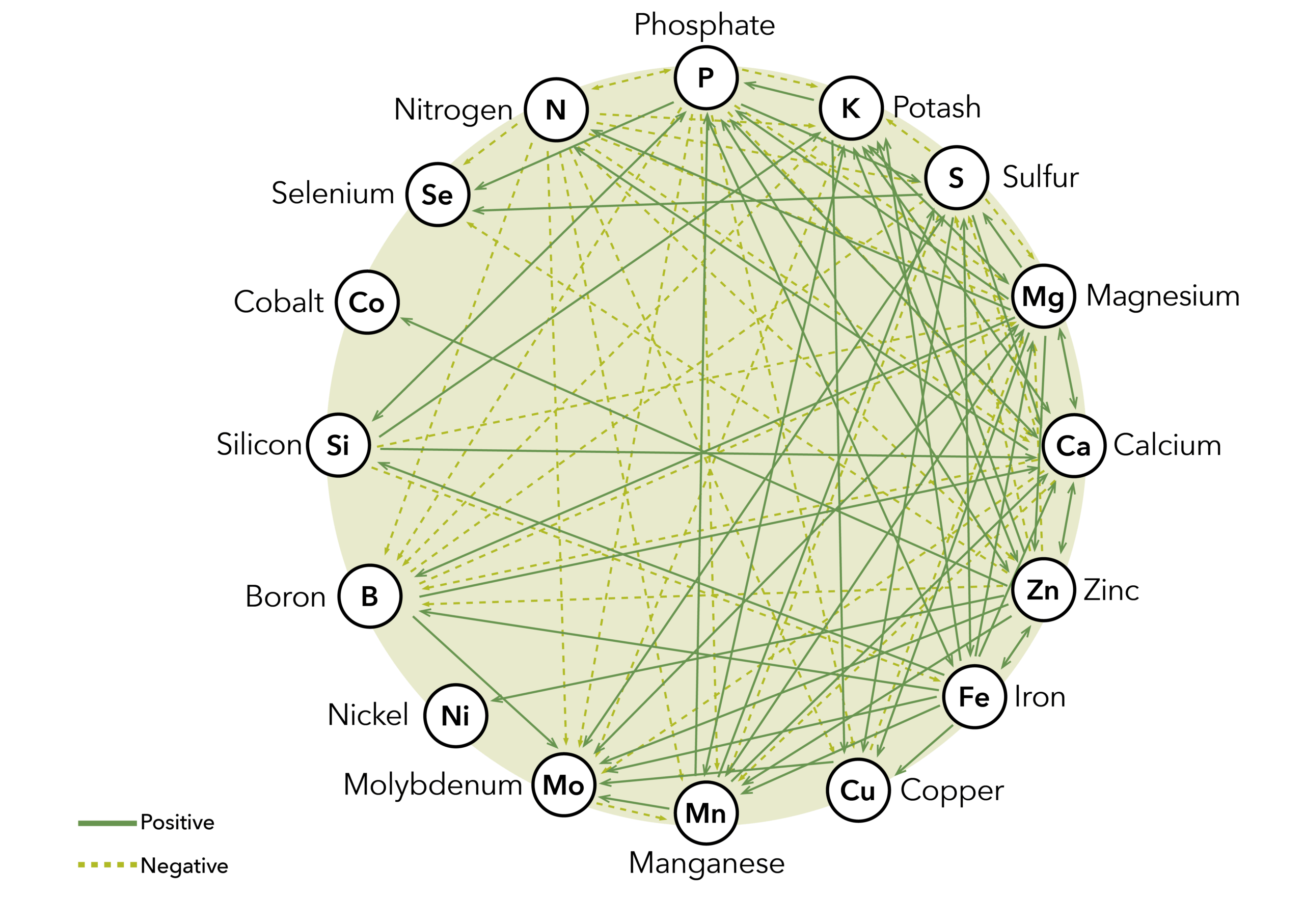
Figure 1: A nutrient interaction chart demonstrating the relationships between macro- and micronutrients in the soil. Positive interactions are noted through solid green lines and negative interactions are noted through dotted green lines. Source: Fan, X., Zhou, X., Tang, M., and Xie. X. Frontiers in Plant Science 2021
Nutrient interaction charts like this have been used by industry leaders to better understand how nutrients affect each other in the soil and how they work together to support crop production.
The essence of these interactions is that more isn’t always better. The best approach to nutrient management is holistic in nature – maintaining sufficient levels of all key nutrients in the field. This balance is essential for optimal plant health and growth.
Phosphorus and Sulfur: Key Interactions
Phosphorus (P) and sulfur (S) are both critical nutrients featured in various nutrient interaction and acquisition charts. They both play an essential role in energy processes, protein synthesis and overall plant growth. But their impact extends well beyond their individual roles in the field. Both nutrients can significantly influence the uptake of other vital nutrients.
Phosphorus has both synergistic and antagonistic relationships in the soil. Adequate levels of phosphorus can enhance its availability and aid in the uptake of sulfur by the crop – a critical nutrient needed for chlorophyll production, protein production and plant growth. Phosphorus also has a positive relationship with selenium and can help influence its availability in the soil. However, when phosphorus levels are too high, it can hinder the uptake of potassium, calcium, boron, manganese, nitrogen, magnesium and copper – all essential nutrients required for crop production. That’s why it’s important to implement a balanced approach to crop nutrition, considering each nutrient interaction and the need for balance in the soil.²
Sulfur also has both synergistic and antagonistic relationships with other nutrients. Adequate levels of sulfur can enhance the availability of, and aid in the use of, selenium, copper and calcium – critical nutrients all essential to a variety of processes within a plant. However, when sulfur levels are too high, it can negatively impact the availability of magnesium, potassium, manganese, boron and nitrogen – each vital for plant production.²
Unlocking Synergy with Phosphorus and Sulfur
Research also shows that you can drive synergy when you apply sulfur and phosphorus together.
In previous Smart Nutrition MAP+MST corn trials, we found that monoammonium phosphate (MAP) gave growers an average yield of 189 bushels per acre when applied alone. But when applied with sulfur, using Smart Nutrition MAP+MST, the synergistic reaction increased yields to 204 bushels an acre – demonstrating how these two nutrients can provide growers with a greater yield advantage when applied together than when applied on their own.
What It All Means
Exploring various nutrient interactions helps us better understand how complex our soil truly is while giving us a better idea of what’s happening beneath the surface every growing season.
While it’s common for us to apply as many of our vital nutrients as possible, various nutrient interactions demonstrate that more isn’t always better, and that nutrient availability can’t always be increased by adding more. Each nutrient must be applied in balance with the rest of your fertilizer program.
Test Your Soil and Adjust Your Approach
A better understanding of how nutrients interact in your soil will help you take a more strategic approach to your fertilizer programs. We recommend that you begin with a soil test to give you a better idea of the plant availability of all your essential nutrients. You can then take a closer look at each nutrient and chart their relationships for specific interactions in the field. Finally, you can adjust your nutrient management program to directly consider critical nutrient interactions and ensure each nutrient is in balance with the others in your soil.
Learn more about critical nutrient interactions and how Smart Nutrition MAP+MST can help you drive synergy in the field with the following resources:
Better Together: The Synergies of Applying Sulfur and Phosphate
Grower’s Guide: Phosphorus, Sulfur and Soil Management
Phosphate Sulfur Synergy of Smart Nutrition MAP+MST
Why are MAP and MST Better Together?
Sources:
¹Michigan State University, More Reasons for Soil Testing
²Fan, X., Zhou, X., Chen, H., Tang, M., and Xie, X. (2021). Cross-Talks Between Macro- and Micronutrient Uptake and Signaling in Plants. Frontiers in Plant Science Journal. https://doi.org/10.3389/fpls.2021.663477