Are You Following The 4Rs of Sulfur Fertilization?
The growth of high-yielding crops and reductions in the atmospheric deposition of sulfur due to the control of air pollutants have resulted in greater sulfur deficiencies around the world. As a result, a growing number of farmers are taking a closer look at the need for sulfur fertilization.
As you begin to evaluate your field’s need for sulfur and consider adding the macronutrient to your fertilizer program, the 4Rs of nutrient management can help you get the most from your sulfur investment. The principles of 4R Nutrient Stewardship can help optimize nutrient use, maximize plant uptake, minimize nutrient loss, improve profitability, increase productivity and enhance sustainability. The framework encourages the use of the right source of fertilizer, at the right rate, at the right time and in the right place. The 4Rs help you improve your input program and make the most of the sulfur you invest in every season.
Let’s take a closer look at how you can use the 4Rs to create a successful sulfur fertilization program.
The Right Rate
Applying the right rate of fertilizer allows you to make the most of your fertilizer investment and avoid over or under applying nutrients to your growing crops. Applying the right rate of each nutrient allows you to maximize your crop’s yield potential and your profitability.
Determining the right rate of sulfur to apply to your soil is extremely important, especially if you’ve identified a deficiency.¹ Yield goals, soil conditions and the sulfur available in your soil should all be considered when determining the right rate.
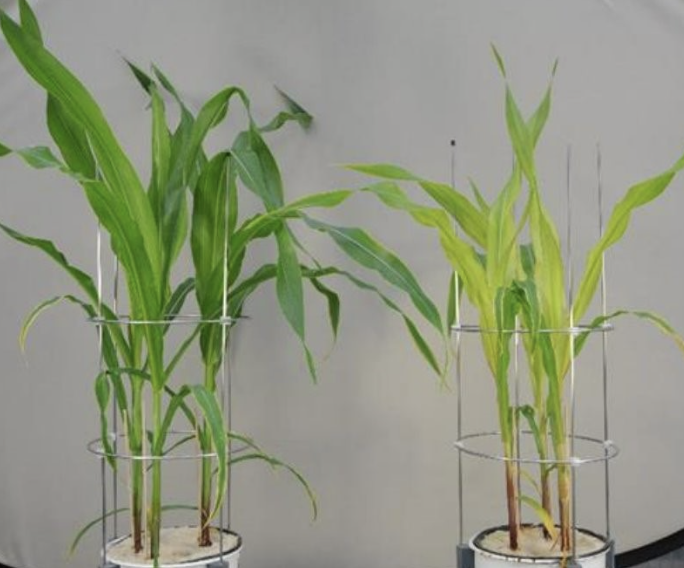
Figure 1: Image of a healthy plant (left) compared to a sulfur deficient plant (right). The plant experiencing a sulfur deficiency has developed yellowing in newer leaves. Source: YARA, 2025, Sulfur Deficiency-Corn.
While soil testing is typically used to determine crop needs and the right fertilizer rates, it can be harder to predict a crop’s yield response to sulfur fertilization with soil testing alone. According to the University of Nebraska-Lincoln’s new sulfur management guide, four steps should be taken to determine the need for sulfur fertilization.¹
Step 1: Outline Site Conditions
- Sandy soils with high leaching potential
- Low organic matter
- No-till
- No and/or sparse manure applications
- Low irrigation or low water sulfate content
- High-yielding fields
- Non-irrigated winter crops
- No shallow water table
- Lack of fallow
- Presence of grass-based residues
- If these conditions are not present, there is a lower probability that you will need to apply additional sulfur through your fertilizer program.
Your fields’ conditions are key factors that can help determine the need for sulfur fertilization and the probability of deficiency. Sulfur deficiency is most common when you experience three or more of the following conditions:
Step 2: Pre-Plant Soil Testing
- If your field experiences three or more of the above conditions, the likelihood of a sulfur deficiency is quite high. In these conditions, a pre-plant soil test can help determine the need for fertilization. If your soil tests below 8 ppm with an organic matter of less than one percent, sulfur fertilization is recommended.¹
Step 3: Mid-Season Plant Analysis
- If you have passed the window for pre-plant soil testing, a plant tissue analysis can help determine the plant availability of sulfur in your soil. If your analysis shows that you are below the proposed threshold for your planted crop, sulfur fertilization is recommended.¹
Step 4: Post-Harvest Analysis
- Post-harvest grain samples can help determine sulfur concentration and the amount removed and used by the crop.¹ These insights can help you understand the need for sulfur in your soil and cropping systems and better determine optimum rates for the following growing season.
Expert Insight: In Nebraska, sulfur fertilization rates should generally not exceed 25 pounds per acre.¹
The Right Time
Applying your fertilizer at the right time ensures that your crops can access the nutrients they need, when they need them. As one of the four macronutrients critical to crop growth, sulfur is needed throughout various stages of plant development. Applying your sulfur at planting or during early vegetative periods can help supply the sulfur your crops demand. When using an elemental sulfur-based fertilizer, pre-plant applications are generally most successful as they reduce leaching losses, give soil microbes time to transform the material into its plants available form and provide residual sulfur for future crops.¹
Expert Insight: Explore your crop’s typical uptake patterns to better align application timing with periods of high plant uptake. See the example below to explore the uptake of sulfur throughout the various stages of corn growth and development (Figure 2).
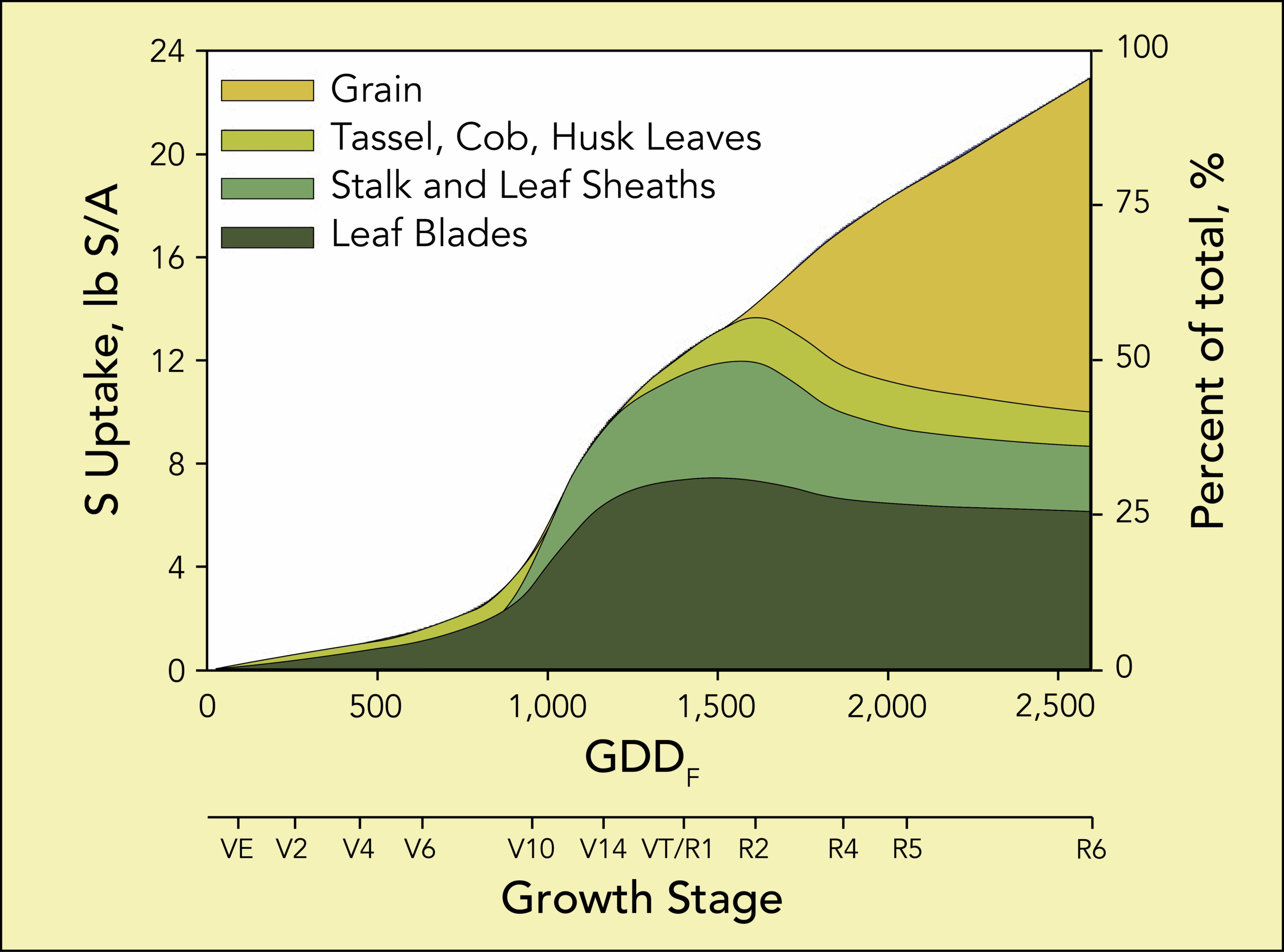
Figure 2: Total uptake of sulfur by corn crops across four plant stover fractions including leaf, stalk, reproductive and grain tissues. Each value represents the average of six hybrids across two years of growth in Illinois. Source: University of Illinois.
The Right Place
Applying your sulfur in the right place allows you to maximize plant uptake and minimize loss. When applying sulfate fertilizers, there is generally no expected yield difference through broadcast or band applications as sulfate is a mobile anion that moves freely through the rooting zone and is immediately available to plants.¹ However, elemental sulfur fertilizers may have more success with broadcast applications followed by incorporation as it can help improve the exposure of elemental sulfur to soil microbes. This can help the sulfate reach plant roots once microbes are finished converting it from elemental sulfur into its plant available form (sulfate).
Expert Insight: Source is important when determining the best place to apply your fertilizer. The solubility and characteristics of your sulfur source should be carefully considered when making decisions about placement.
The Right Source
Various sources of sulfur are available to add to your fertilizer program. Speak to your local agronomist or crop advisor when considering the best sulfur fertilizer source for your field.
Sulfate Fertilizers
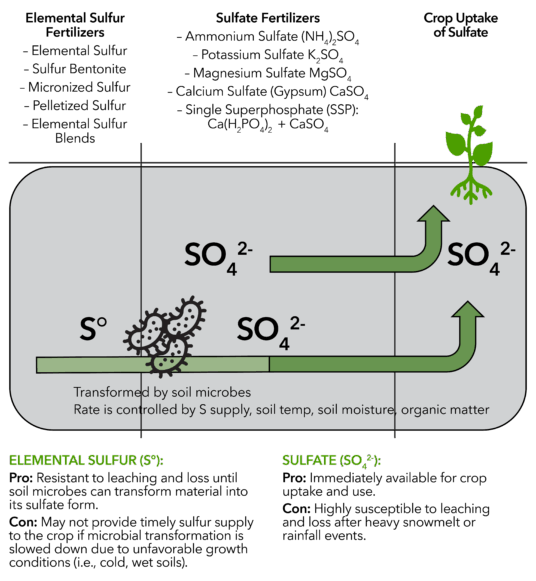
Sulfate fertilizers provide a readily available form of sulfur that can be immediately accessed by crops. However, these traditional sulfur sources can be prone to loss through leaching and can prevent maximum crop uptake.
Elemental Sulfur-Based Fertilizers
Elemental sulfur fertilizers, on the other hand, must convert sulfur into its plant available form based on soil conditions, helping to prevent leaching losses and increase uptake while protecting your fertilizer investment. However, traditional elemental sulfur formulations convert sulfur too slowly to match crop demand. That’s why we created Micronized Sulfur Technology (MST), a technology formulated for Smart Nutrition™ MAP+MST® that can quickly oxidate elemental sulfur into the sulfate form to provide sulfur throughout the entire growing season and match nutrient release with crop demand.
The Value of Smart Nutrition MAP+MST
While sulfate fertilizers are immediately available to growing crops, they are also prone to significant loss. Smart Nutrition MAP+MST prevents the loss of nutrients through leaching as it must be oxidized into its plant available form before becoming plant available, helping you reduce loss and protect your fertilizer investment.
And as an added bonus, Smart Nutrition MAP+MST combines phosphorus and sulfur to promote balanced crop nutrition and the efficient use of fertilizer across every field. By combining sulfur and phosphorus into one homogeneous granule, growers can unlock a significant yield advantage; taking you from 189 bushels an acre of corn to 204. These two nutrients have a synergistic relationship that can deliver greater yields and crop quality when applied together rather than on their own. Plus, you can simplify your nutrient management plan by delivering two key nutrients in one fertilizer package.
Looking Ahead
Growers who implement 4R Nutrient Stewardship practices make the most of each dollar they invest into their nutrient management programs. See the difference that the right source of fertilizer can make in your field with Smart Nutrition MAP+MST when you reach out to your local rep.
Want to learn more about how you can enhance your sulfur fertilizer program and nutrient management plan? Dig into the following resources to learn more:
Smart Nutrition™ MAP+MST® and 4R Nutrient Stewardship
Comparing Sulfur Fertilizer Sources: Elemental vs. Sulfate
Sulfur is Essential For Optimum Plant Growth
Are You Considering Applying Sulfur This Year?
How Long Does Sulfur Stay In Your Soil?
How Smart Nutrition MAP+MST® Differs from Traditional Sulfur Fertilizer
Sulfur Nutrient Management Practices
Sources:
- ¹University of Nebraska-Lincoln, New NebGuide: Sulfur Management in Agricultural Systems of Nebraska
- ²American Society of Agronomy, Crops & Soils Magazine, Sulfur 4R Management and the Changing Landscape of Fertility
- University of Illinois, Modern Corn Hybrids’ Nutrient Uptake Patterns